Strengths and tradeoffs
- A clearly defined application supported by the recorded assembly and available response information.
- Neither the 12K label nor the sponsor supplies stiffness measurements.
Specifications and exact identity
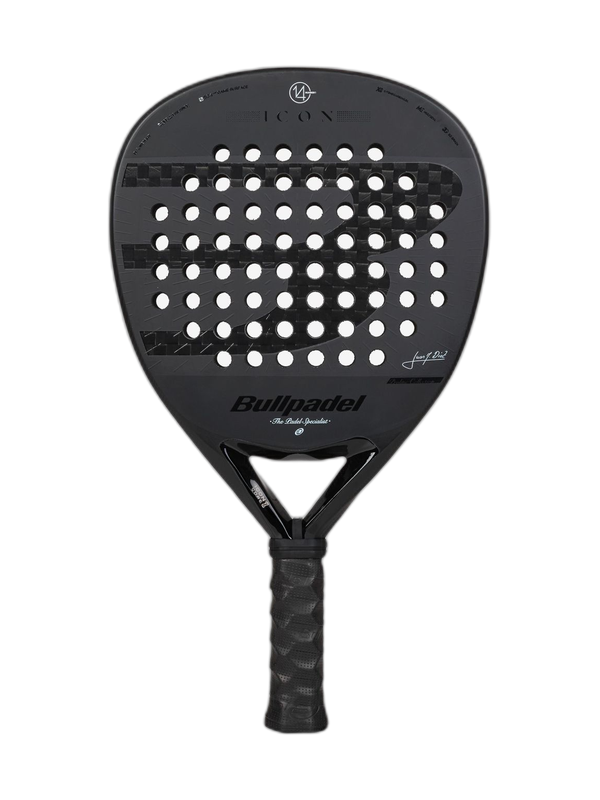
The retained official Icon 27 record identifies 497246: 370–375 g, diamond, approximately 26.3 cm balance, Xtend Carbon 12K and MultiEVA. Its declared firm precision brief is contextual, not measured performance.
Playing profile and practical use
This is a bounded editorial estimate from the exact construction and stated application. The loaded diamond assembly pairs substantial mass with a supported firm face and multi-response core for strong prepared acceleration and committed output, but this requires an early full swing. Prepared central volleys, lobs and overheads are the reference contacts; passive rebound is considered separately from committed finishing. We have not performed a court test of this racket.
Neither the 12K label nor the sponsor supplies stiffness measurements. Fast resets and edge contact are the principal limits. Each dimension has a plausible ±1-point editorial scenario range; these are not confidence intervals. Grip, protector, specimen, temperature and player preparation can change the result.
Power
The loaded diamond assembly pairs substantial mass with a supported firm face and multi-response core for strong prepared acceleration and committed output, but this requires an early full swing. This is an editorial potential estimate with ±1-point scenarios.
Attacking output concerns a prepared stroke, not just the rebound that helps a short defensive swing. Check whether a deliberately accelerated volley and overhead produce the depth you need.
Control
The firm-face whole assembly and substantial prepared contact mass support a strong central precision hypothesis across volleys and overhead placement; late or low-input launch remains less certain. This is an editorial potential estimate with ±1-point scenarios.
Control concerns predictable direction when you prepare the contact. That differs from how readily a racket rescues a mistimed stroke. Include both a placed volley and a controlled lob in your own comparison.
Maneuverability
The 370–375 g range and 26.3 cm distribution allow useful ordinary preparation once set, but repeated fast directional changes carry a clear load demand. This is an editorial potential estimate with ±1-point scenarios.
Handling concerns preparation and getting ready for the next shot. Listed weight and balance describe context but do not measure swingweight. Grip and protectors change the finished setup.
Comfort
MultiEVA provides an impact-access mechanism within the firm face and substantial mass, supporting competent central contact; heavy head load limits sustained accessibility. This is an editorial potential estimate with ±1-point scenarios.
Comfort combines contact feel with the demands of repeated preparation. A soft core alone cannot establish the response of the entire racket or suitability for an existing physical complaint.
Forgiveness
Central region access is useful for a prepared attacker and mass can support mild-miss delivery, but the head-oriented firm contact requires accurate positioning to retain depth and direction. This is an editorial potential estimate with ±1-point scenarios.
Forgiveness combines access to useful contact with retained depth and direction when contact is imperfect. A large-looking head is not a measured map of useful response.
Who does this racket suit?
This is a bounded editorial estimate from the exact construction and stated application. The loaded diamond assembly pairs substantial mass with a supported firm face and multi-response core for strong prepared acceleration and committed output, but this requires an early full swing.
Try routine placement, compact defense, repeated net preparation and a full overhead with your normal grip. Choose according to your own contact pattern rather than the largest headline number.
Neither the 12K label nor the sponsor supplies stiffness measurements. Fast resets and edge contact are the principal limits. Each dimension has a plausible ±1-point editorial scenario range; these are not confidence intervals. Grip, protector, specimen, temperature and player preparation can change the result.
Has Padel Chapter physically tested this exact racket?
No. This is an editorial assessment using verified product information and available external context. It does not represent a measured laboratory or personal court result.
How should I use a small numerical difference?
Use the dimension profile and stated limitations first. Setup and player scenarios overlap. A half-step estimate or a tenth overall does not by itself establish a performance winner.
Sources and uncertainty
This review is an independent editorial assessment by Padel Chapter, based on product specifications, technical research and available external information. Padel Chapter has not personally tested this racket on court.
These are contextual editorial estimates, not physical measurements. Adjacent score scenarios overlap. Temperature, finished grip, timing and incoming pace can change the response.