Play and contact
Double carbon restraint, Pro50 and headward adult mass support strong prepared attacking potential, without establishing exceptional high-input finishing. The supported layered face and Pro50 response support strong prepared placements, with unknown compression under high pace bounding a stronger precision judgment. Headward distribution and 355-380 g support functional but demanding rapid reset; the extended handle changes grip leverage and setup sensitivity. Layered restraint and Pro50 imply a demanding impact hypothesis combined with repeated head load; damping marketing does not erase this load. The central teardrop region can be used reliably with preparation and frame support can limit small-miss twisting, while late or peripheral retained depth stays selective.
The proposal assumes an ordinary specimen in the stated range with a normal finished grip and no extra head weight. Upper-range mass, late contact, far-edge impact and hard incoming pace can change preparation, feel and retained depth or direction. Neither swingweight, contact maps nor repeated-load outcomes were measured. Exact retailer specifies Pro50 but calls it medium density in prose and stiff in its table; the brand launch calls Pro50 hard in Brava. No numeric hardness is asserted. The scenario spans medium to hard response and does not claim Brava whole-racket equivalence.
Specifications and exact identity
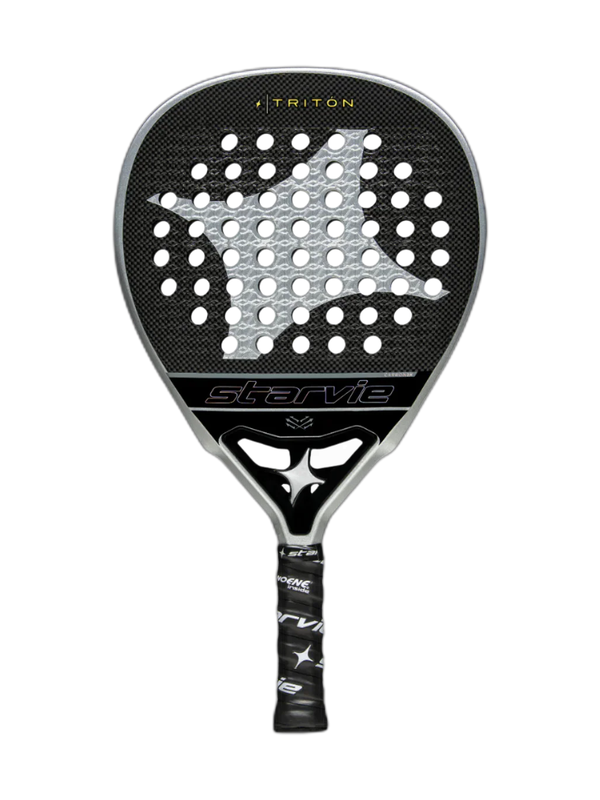
The exact Triton Pro 2025 retailer specifies two3K carbon layers,Pro50 EVA and355-380g. Balance is called balanced in the table and slightly head-heavy in the body; foam is called medium density in prose and stiff/power in the table. These are retained alternative descriptions, not a verified high balance or measured hard core. The manufacturer launch calls Pro50 hard for Brava; that does not establish the whole Triton response.
Power
Double carbon layers, declared Pro50 and adult mass jointly support strong prepared overhead and volley potential under either medium or stiffer foam scenario.7.5 understates prepared assembly potential;8.5 is withheld because acceleration and finishing response are unmeasured.
Attacking output concerns a prepared stroke, not just the rebound that helps a short defensive swing. Check whether a deliberately accelerated volley and overhead produce the depth you need.
Control
Double-layer restraint and prepared central contact support strong ordinary placement potential across the medium-to-stiffer foam scenarios.7.5 understates that supported precision hypothesis;8.5 is withheld for rapid input variation and late contact.